What Parallel Exists Between the De Lacey Family's History and the Creatures Own Plight
The DeLacey Family tin can exist found in Volume two of Mary Shelley'due south Frankenstein. Though the family and the monster have minimum interaction, they play a major role in the monster'due south development as a graphic symbol. Equally the monster wanders the countryside to escape the wrath of the outset boondocks he discovers, he builds a modest domicile to view the outside world from a distance. He comes to report a poor, peasant family. The commencement member of the family the monster observes is a young woman named Agatha. The monster notes her apparently way of dressing and her "patient, nevertheless sad" countenance as she does her chores (Shelley, 79). The monster subsequently sees a boyfriend named Felix and recalls his countenance as ane of "a deeper despondence" (Shelley, 79). During his observation, the monster realizes that role of the "home" he created allows him to see into the house of the blood brother and sister he had been watching. Every bit he peers through the cottage, he observes "an onetime man, leaning with his caput on his hands in a disconsolate attitude" (Shelley, fourscore). The monster learns that this is the leader of the family, a bullheaded human named DeLacey. The monster begins to admire the family's nights of music-playing and story-telling. Despite the family unit's honey for ane another, the monster observes the continuation of their commonage sadness until the inflow of an Arabian woman. The monster shares that the new addition to the family is Felix's love, Safie. He learns that Safie and Felix were separated after Safie'southward father "became obnoxious to the authorities", which led to the family's sadness (Shelley, 92). Afterwards witnessing their blithesome reunion, the monster begins his cocky-education through observation of Felix'south pedagogy lessons for Safie and books he finds in the woods. 1 night, when DeLacey is dwelling alone, the monster finds the courage to finally run into him. Their seemingly successful conversation comes to a screeching halt when DeLacey's family unit enters the cottage and attacks the monster out of fright. This come across fuels the monster'southward anger for his creator, Frankenstein.
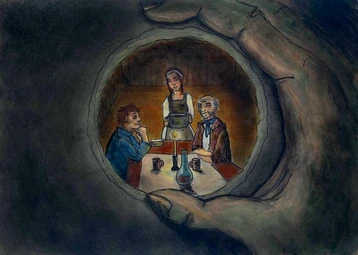
The monster observing the DeLaceys through the hole in his dwelling. (Veronica Eitherangel, November 20, 2012).
Contents
- one Major Themes
- i.1 Sympathy
- one.2 Family unit
- two Bear upon in Frankenstein
- 3 References and Suggestions for Further Reading
Major Themes
Sympathy
The monster's observation of the DeLacey family unit teaches him the concept of sympathy. He becomes aware of the family unit's financial situation through close observation of their behavior. The monster recalls, "A considerable period elapsed before I discovered one of the causes of the uneasiness of this amiable family; information technology was poverty: and they suffered that evil in a very distressing degree"(Shelley, 82). Not long into the monster's development, he begins to understand the concept of grade. This understanding allows him to come across the battle the family is facing with their ability to produce their own means of survival.
Initially, the monster steals the family's food and firewood as a mode to ensure his own survival. The monster shares, "I had been accustomed, during the night, to steal a part of their shop for my own consumption; only when I found that in doing this I inflicted pain on the cottagers, I abstained, and satisfied myself with berries, nuts, and roots, which I gathered from a neighboring forest" (Shelley, 82). Later close observation, the monster comes to the realization that the family he is stealing from is ane of meager means. Seeing how this affects the family, which he refers to as the infliction of pain, shows the monster's comprehension of the emotions of others.
The family'due south suffering causes the monster to change his behavior from a thief to a giver as he becomes the family's cloak-and-dagger supplier of firewood. The monster shares, "I institute that the youth spent a not bad part of each day in collecting wood for the family fire; and, during the dark, I often took his tools, the utilize of which I quickly discovered, and brought habitation firing sufficient for the consumption of several days" (Shelley, 82). The monster's sympathy and admiration for the DeLaceys is captured with this gesture. Sympathizing with their condition of poverty and realizing his contribution to their limited resources, results in his aid with gathering woods to assist the DeLaceys survive the cold weather.
Family
Through his ascertainment of the DeLaceys, the monster learns that DeLacey is a blind man. The monster becomes fascinated by the relationship between the father and his two children. He observes, "Nothing could exceed the love and respect which the younger cottagers exhibited towards their venerable companion. They performed towards him every little part of amore and duty with gentleness; and he rewarded them with his benevolent smiles" (Shelley, 82). The monster's understanding of family begins with his analysis of the relationship between the 3 family unit members. He sees the kind handling that is reciprocated from parent to kid. Felix and Agatha serve their father through their work around the house, and they are rewarded by the affection and appreciation of their father, which is shown through his "benevolent smiles".
The monster is able to encounter the love behind the deportment of each family member that serve the greater good of the family unit. The monster recalls memories of Felix'south kindness towards Agatha. He remembers, "In the midst of poverty and want, Felix carried with pleasance to his sister the first little white blossom that peeped out from beneath the snowy ground" (Shelley, 84). With this gesture, the monster learns that the DeLacey family, despite limited means and distress, still place an incredible value on sharing their love for 1 another. The monster also recalls Felix waking up before his begetter and sister to clear paths through the snowfall for Agatha's chores, gathering wood for the family's fire and drawing water for the family unit to drinkable. Felix's actions put him in a fatherly role, as he is the one to take the responsibility of caring for his family because of his male parent's disability to practice so. His power to put his family's needs before his own, shows the love that has been engrained in the DeLaceys.
The monster's observation of the love the family members have for one another is both a do good to the monster's understanding of family life, as he comes to require such a tight-knit relationship, too as a detriment, as he comes to the realization that he volition never exist a office of such a unit of measurement.
After close observation of the family, the monster is able to get familiar with their language, every bit he is able to understand a certain corporeality of their words and produce some of his ain. When Safie arrives, the monster reports her use of a language unfamiliar to him. To break down this linguistic communication barrier, Felix uses his mastery of language to teach Safie. The monster observes these lessons and uses the educational activity for the continuation of his own skills. The monster remembers, "Presently I found, past the frequent recurrence of ane sound which the stranger repeated subsequently them, that she was endeavouring to learn their language; and the idea instantly occurred to me, that I should make apply of the aforementioned instructions to the same end" (Shelley, 88). The didactics of Safie runs parallel with the instruction of the monster. Safie and the monster both learn the science of messages, besides every bit their meanings when combined in diverse ways.
This teaching is conducted through basic teaching and the utilize of C.F. Volney'southward Ruins of Empires. In one case the monster reaches a high level of literacy, he continues his self-education through John Milton'southward Paradise Lost, Plutarch's Lives and Johann Wolfgang von Goethe'southward Sorrows of Werter, all of which he finds in a purse in the woods. The books not only assist the monster in obtaining a greater agreement of language, but open up his eyes to a world of emotion, feeling and experience. The monster shares, "I tin hardly depict to you the effect of these books. They produced in me and infinity of new images and feelings, that sometimes raised me to ecstasy, simply more than frequently sunk me into the lowest dejection" (Shelley, 96). The written word causes the monster to question his beingness. This questioning breeds more than hate for his creator as he grows to despise his hated and feared status.
Touch on in Frankenstein
The theme of forgiveness encourages the monster's growth as a grapheme. Forgiveness allows him to understand right from incorrect and good from bad. From stalking the family, the monster becomes aware of the DeLacey'south poverty and develops feelings of remorse for his actions, so he becomes the silent supplier of the family's firewood. The monster'due south sympathetic nature contributes to his development every bit complex grapheme with the censor of a human being simply the appearance of a monster.
The theme of education inspired past the monster'due south observation of the DeLaceys proves to be both a blessing and a detriment to his development equally a character. Initially, the monster is satisfied with achieving a bones understanding of the family'south communication, only this small taste of knowledge drives the monster to continue the expansion of his education. Afterwards observing Felix's didactics of Safie, the monster desires to go fifty-fifty more aware of the outside world. He conducts this self-education through Paradise Lost, Plutarch'due south Lives, and Sorrows of Werter. These books amend his comprehension of written language, but bring to his attending the realities of his condition. He begins to question his existence—who he is and what meaning his life has. These questions ultimately cause his ruin every bit he comes to the understanding that he is a brute without a singled-out place in club. This realization contributes to his swelling anger towards his creator, Frankenstein.
References and Suggestions for Further Reading
Buchen, Irving H. "Frankenstein and the Abracadabra of Cosmos and Development." JSTOR. Marilyn Gaull, Leap 1977. Web. 16 Feb. 2015.
http://knarf.english.upenn.edu/Manufactures/buchen.html l
"The Family of De Lacey." The Life and Times of The Cosmos. Due north.p., n.d. Web. 16 Feb. 2015.
http://redpandasfrankenstein8-3.weebly.com/the-family-of-de-lacey.html
"Romantic Circles." Wollstonecraft Shelley, Mary. Ed. Neil Fraistat. University of Maryland, May 2009. Web. 16 February. 2015.
http://www.rc.umd.edu/editions/frankenstein
Shelley, Mary Due west. Frankenstein. 2nd ed. New York: Pearson Education, 2007. Impress.
Source: https://mary-shelley.fandom.com/wiki/The_DeLacey_Family
0 Response to "What Parallel Exists Between the De Lacey Family's History and the Creatures Own Plight"
Postar um comentário